Pharmaceutical cold chain packaging must perform as a system. Insulation, refrigerants, payload geometry, component conditioning, assembly methods, route duration, and environmental exposure all influence whether the required temperature range can be maintained during distribution.
Selecting materials from a product catalog is therefore only one part of the process. Pharmaceutical manufacturers, specialty pharmacies, compounding operations, and healthcare distributors also need evidence that the assembled configuration is appropriate for the conditions it is expected to encounter.
Nordic Cold Chain Solutions combines pharmaceutical packaging products with laboratory, engineering, qualification, kitting, and conditioning capabilities. This integrated approach helps organizations move from a preliminary packaging idea to a controlled configuration that can be evaluated, documented, and executed consistently.
Why Individual Components Cannot Be Evaluated in Isolation
A thermal shipper may use molded EPS, cotton insulation, polyurethane, or another material to reduce heat transfer. Refrigerants absorb or release thermal energy. Corrugated cartons provide exterior structure. Internal dividers control product placement. Data loggers capture temperature information.

Each component has a role, but the performance of one item does not define the performance of the complete package.
A refrigerant that performs well in one configuration may behave differently when the payload volume changes. A shipper selected for a regional route may not provide sufficient duration for a national lane. An insulation system evaluated with a dense payload may respond differently when used with a small number of lightweight vials.
The assembled system must therefore be considered in relation to:
- Product temperature requirements
- Payload size and thermal mass
- Refrigerant type and conditioning state
- Expected shipping duration
- Seasonal ambient conditions
- Carrier service level
- Internal arrangement
- Pack-out and staging procedures
- Receiving expectations
This system-level view is essential for biologics, biosimilars, vaccines, sterile preparations, and other therapies whose quality or efficacy may be affected by temperature exposure.
Temperature Profiling Defines the Actual Challenge
Before a packaging system can be meaningfully evaluated, the expected environment must be understood. Nordic’s cold chain lab services include temperature profiling to assess conditions that may affect the product during storage and transport.

Profiling can help organizations determine whether a lane experiences consistent ambient exposure or rapid fluctuations. It can also reveal whether risk is concentrated during a particular phase, such as origin staging, a carrier hub, local delivery, or post-delivery dwell.
A pharmaceutical shipper should not be designed solely around a general assumption that summer is hot or winter is cold. The relevant question is how the package is likely to experience those conditions over time.
This analysis can influence the choice of insulation, refrigerant quantity, shipper dimensions, and payload placement. It can also clarify whether separate seasonal pack-outs are warranted.
Thermal Packaging Evaluation Converts Assumptions Into Data
Thermal packaging evaluation examines how a complete configuration performs under defined conditions. Nordic’s laboratory can assess insulation systems, packaging designs, and component arrangements to determine whether the configuration produces the intended protective response.
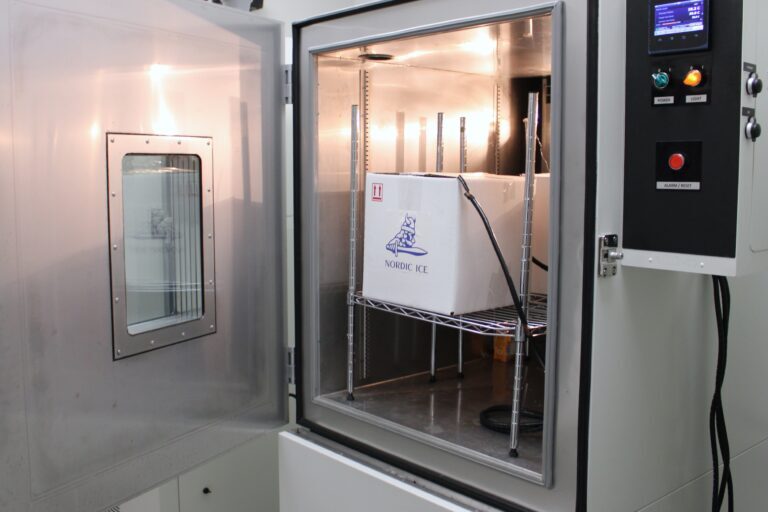
During evaluation, the package may be assembled with a representative payload and exposed to a controlled environmental profile. Sensors placed within the system record temperature behavior over time.
The resulting data may identify:
- The time required for the payload to approach a temperature limit
- Differences between internal measurement locations
- Areas where refrigerant proximity creates excessive cooling
- The influence of payload density or void space
- Whether the configuration provides sufficient duration
- How performance changes under alternate ambient profiles
These findings allow the packaging design to be refined before broader deployment. Refrigerant quantity may be adjusted, internal spacing changed, insulation modified, or a different shipper size selected.
Environmental Testing Prepares the System for Distribution Stress
Real-world distribution rarely produces a constant ambient temperature. A parcel may move between conditioned and unconditioned environments several times. It can encounter heat, cold, humidity, delays, and handling transitions during a single journey.

Environmental testing simulates these changing conditions in a controlled setting. This makes it possible to study the package’s response without relying entirely on live shipments, where exact exposure can be difficult to reproduce.
For pharmaceutical programs, environmental testing is especially useful when:
- A product is launching into new geographic regions
- Transit duration is being extended
- Carrier service levels are changing
- A packaging material is being replaced
- A payload configuration has been modified
- The organization is preparing for seasonal extremes
- A lower-cost or lower-waste option is being considered
Testing can reveal whether a revised configuration maintains the necessary margin or whether additional adjustments are required.
Qualification Supports Defined Use
Qualification establishes that the packaging system is suitable for its intended application under specified conditions. It should connect the test design with the product profile, route assumptions, pack-out procedure, and acceptance criteria.
Nordic’s lab and consulting resources can help organizations navigate this process while aligning packaging decisions with internal quality expectations and applicable distribution practices.
A qualification-oriented program typically defines:
- The product temperature range
- The intended shipment duration
- The ambient test profile
- The payload configuration
- The refrigerant conditioning method
- The sensor locations
- The acceptance criteria
- The assembly and staging procedure
This creates a clear basis for evaluation and later execution.
Nordic also provides design-tested packaging options, including cotton and EPS shipper configurations developed to address recognized temperature-testing requirements such as ISTA 7E profiles. A design-tested option can provide a strong starting point, although the organization still needs to determine whether the configuration aligns with its specific product, payload, lane, and operational requirements.
Operational Readiness Must Follow Laboratory Performance
A successful laboratory result does not automatically guarantee consistent field execution. The pack-out must be transferred from the controlled test environment to daily operations without losing critical steps.
Conditioning services can help ensure that refrigerants are prepared to a defined state before use. Kitting services can organize insulation, cartons, refrigerants, dividers, labels, and other components into a repeatable set. Written procedures can define assembly sequence, product placement, staging limits, and release timing.
These capabilities reduce the number of decisions operators need to make during active fulfillment. Instead of gathering components independently or interpreting a configuration from memory, staff can follow a structured process.
For organizations shipping at higher volume, this can improve throughput while reducing variation between shifts and facilities.
Sustainability Requires Performance-Based Evaluation
Pharmaceutical companies are increasingly examining packaging waste, material use, storage demands, and transportation efficiency. Nordic offers options such as recycled cotton insulation and Drain Safe® gel packs to help organizations pursue more sustainable cold chain strategies.
Sustainability decisions should still be evaluated through the same performance discipline applied to conventional packaging. A lower-waste material must remain appropriate for the product, route, and required duration.
Laboratory evaluation can help determine where packaging can be reduced without compromising the protective objective. It can also identify situations where a flexible cotton mailer is sufficient and where a rigid EPS or higher-performance shipper remains necessary.
This avoids treating sustainability as a purely material-based substitution. The stronger approach is to optimize the total system.
A More Defensible Pharmaceutical Packaging Program
Pharmaceutical distribution requires packaging decisions that can be explained, repeated, and improved. That requires a clear connection between the product requirement, the proposed configuration, the test method, and the operational procedure.
Nordic Cold Chain Solutions brings those elements together through thermal packaging, refrigerants, lab services, environmental testing, qualification, conditioning, kitting, consulting, and product engineering.
The result is a more structured path from packaging concept to field-ready execution. Instead of relying on generalized assumptions, organizations can build cold chain systems around defined requirements and measurable performance.