Peptide distribution is moving into a new operational phase. What was once associated primarily with research settings and limited specialty use is increasingly part of compounding pharmacy programs, wellness clinics, longevity protocols, specialty pharmacy fulfillment, and direct-to-patient care.
That growth changes the cold chain challenge.
Peptide therapies are frequently shipped as compact payloads with specific stability requirements. Semaglutide, tirzepatide, BPC-157, CJC-1295 with Ipamorelin, and other peptide therapies may require refrigerated 2–8°C handling, while products such as thymosin alpha-1 can have different temperature requirements depending on whether they are lyophilized or reconstituted. The result is a shipping environment where product form, transit duration, refrigerant preparation, packaging dimensions, and final-mile exposure all influence the appropriate pack-out.
For organizations scaling peptide cold chain distribution, the goal should not simply be to add more cooling material. It should be to establish a packaging system that can perform repeatedly across orders, personnel, shipping lanes, and seasons.
Nordic Cold Chain Solutions helps pharmacies and healthcare organizations develop that packaging foundation through right-sized thermal components, standardized pack-outs, monitoring options, and configurations built around the realities of small-format pharmaceutical shipping.
Small Payloads Create a Different Thermal Problem
A peptide shipment may contain only a few vials, pens, syringes, or medication components. That compact footprint can make the order appear easier to protect than a larger pharmaceutical shipment.

Thermally, however, small payloads require careful planning.
A limited product mass does not provide the same thermal inertia as a larger load. Ambient conditions can therefore influence a compact package more quickly, particularly during carrier transfers, delivery vehicle exposure, or delayed patient retrieval.
The answer is not necessarily a larger shipper. Oversizing a packaging system can increase freight expense, warehouse requirements, refrigerant usage, and pack-out complexity without proportionally improving performance.
Instead, organizations should evaluate the complete thermal system:
- Required product temperature
- Expected transit duration
- Refrigerant type and conditioning
- Insulation thickness and material
- Payload volume and placement
- Exposure to seasonal ambient conditions
- Potential carrier or weekend delays
- Expected time between delivery and retrieval
These variables determine how much thermal protection a shipment actually needs.
For many recurring peptide programs, a compact insulated configuration can provide an efficient starting point. Higher-risk lanes or longer transit windows may require additional thermal capacity or an alternate shipper.
Why Standardized Components Matter at Scale
Early-stage peptide programs can often rely heavily on experienced staff. A small number of people know how to prepare refrigerants, arrange the payload, close the package, and time carrier pickup.
That model becomes harder to sustain when volume increases.
As additional technicians, pharmacy locations, or fulfillment partners become involved, seemingly minor differences can enter the process. Refrigerants may be conditioned differently. Product placement may shift. One technician may add extra coolant while another uses less. Completed packages may sit in staging for different lengths of time.

A defined component system reduces those variables.
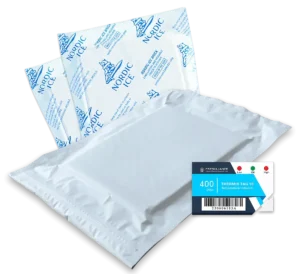
The Nordic GLP-1 Express Pack™ illustrates this type of small-format approach by combining Nordic Ice® Bricks, an insulated expansion mailer, and a Thermis Tag 1E temperature indicator into a coordinated configuration.
While peptide requirements must always be evaluated according to the specific formulation and shipping profile, the broader principle applies across emerging therapies: fewer pack-out decisions can make fulfillment easier to standardize.
Semi-rigid refrigerants are particularly useful where repeatable component geometry matters. Nordic Ice® Bricks retain their form through freezing, thawing, and transportation, helping the package maintain a consistent physical arrangement instead of relying on flexible refrigerants that may shift around the product.
That repeatability can become increasingly valuable when hundreds or thousands of similar packages are assembled each week.
Insulation Should Match the Shipping Window
Insulation is another area where more is not automatically better.
Nordic’s insulated expansion mailers provide a lower-profile alternative to rigid coolers for suitable small-format applications. Available configurations have published performance durations ranging up to 32 hours below 8°C and as long as 36 hours below 15°C, depending on the mailer configuration and test conditions.
That does not mean a published duration should simply be applied to every peptide shipment. Product requirements, lane conditions, coolant configuration, and real operational assumptions still need to be evaluated.
Instead, performance data provides a basis for selecting and qualifying a configuration.
A pharmacy shipping a refrigerated peptide overnight across predictable regional lanes may have very different requirements from a program shipping across the country with potential weekend dwell. Rather than forcing both orders into one package, organizations can create defined packaging tiers based on risk.
A lower-volume program might begin with one or two qualified configurations. As volume increases, those formats can be assigned to specific lane durations or seasonal profiles, reducing the number of decisions fulfillment personnel need to make at the packing station.
Temperature Indicators Add Useful Shipment Visibility
Packaging protects the product, but monitoring can help organizations understand what happened during transportation.
The Thermis Tag 1E single-use temperature indicator included with the Nordic GLP-1 Express Pack™ can be configured around a standard 2–8°C alarm profile or customized based on program requirements. It provides a visual LED indication and can monitor cumulative or single-event temperature excursions.
For peptide programs, monitoring can be especially useful when establishing new lanes, evaluating seasonal performance, troubleshooting delivery issues, or gathering internal quality data.
It should not replace a qualified packaging system. Instead, it provides another layer of information that can help organizations evaluate whether packaging and operating procedures are functioning as intended.
Monitoring information can also help distinguish between different types of problems. If a lane repeatedly experiences excursions, the organization may need to adjust the pack-out, select a different package, alter transit timing, or investigate carrier conditions.
Formulation Must Come Before Packaging
A peptide name alone does not determine the cold chain.
The physical form and preparation state matter.
For example, Nordic identifies BPC-157, semaglutide, tirzepatide, and CJC-1295/Ipamorelin within 2–8°C shipping workflows, while thymosin alpha-1 may require frozen handling when lyophilized and refrigerated conditions after reconstitution.
That difference illustrates why packaging should follow product mapping rather than precede it.
Before establishing a pack-out, pharmacy and clinical teams should confirm the approved or applicable handling conditions for the specific product and formulation. From there, the packaging program can be built around the required temperature range, expected duration, destination, and operating environment.
This becomes particularly important when peptide therapies are combined with GLP-1 medications or other specialty products in broader patient programs.
Building the Packaging Foundation for Peptide Growth
Scaling peptide distribution requires more than selecting an insulated mailer and putting frozen refrigerants around the product. A dependable program connects thermal performance with operational discipline.
That means defining which package applies to each shipment profile, establishing refrigerant conditioning procedures, controlling product placement, documenting pack-out instructions, training personnel, and determining when monitoring should be incorporated.
Nordic Cold Chain Solutions focuses on the packaging infrastructure that allows pharmacies, clinics, and fulfillment partners to execute those workflows consistently.
As peptide therapy volume increases, that repeatability becomes increasingly important. The objective is not merely to keep one shipment within range. It is to create a system capable of producing the same controlled pack-out across hundreds or thousands of shipments under changing real-world conditions.